

Who Can See What Your AI Note-Taker Records?
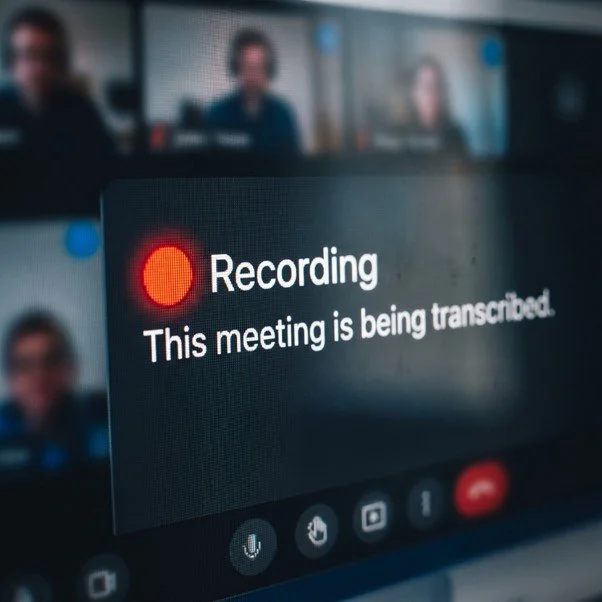
An AI note-taker is a tool that joins a meeting, records the audio and sometimes the video, turns the speech into a written transcript, and produces a summary. Commonly within Microsoft 365 Copilot in Teams.
Most connect to your calendar so they can join automatically, and some will sit in on any meeting on your schedule unless you turn that setting off.
The recording and transcript do not disappear when the call ends. They are saved, usually in the cloud, where they can be searched, shared, and exported later. Where they are saved, and who can reach them, depends on which tool you use.
Who can see the recording?
Start with the obvious group: anyone the meeting organiser shares the summary with.
Many note-takers email the transcript to every attendee by default, and some send it to people who were invited but never joined. When the meeting covered a sensitive topic, that distribution list matters.
Then there is the tool's own access. With a cloud note-taker, the recording sits on the vendor's servers, which means the vendor's systems, and in some cases its staff, can reach it under the terms you agreed to.
If the tool auto-joined from someone's calendar, the recording may live on an account you do not control, belonging to whichever employee connected the bot.
Does the tool use your meetings to train its AI?
This is where tools differ the most, and it is worth checking before you choose one.
Microsoft states that Copilot in Teams does not use your prompts, responses, or meeting content to train its AI models, and that the data stays inside your organization's Microsoft 365 environment. Microsoft's privacy documentation says this directly, and notes the content is processed within the Microsoft 365 service boundary rather than on the public version of the AI.
Third-party note-takers vary widely.
Some store your recordings on their own servers and, depending on the terms you accept, may use that data to improve their models. Others say they do not train on customer data at all. The only way to know is to read the specific tool's privacy terms, because two tools that look almost identical can treat your data very differently.

How to use AI note-takers safely
You don't have to ban these tools to use them responsibly.
Do this instead:
Pick an approved tool and say so. Decide which note-taker your business uses, and ask staff not to connect others to company meetings. This keeps your recordings in one place you control.
Turn off auto-join. Set the tool to join only when someone chooses to record, rather than automatically for every meeting on a calendar.
Announce recording and get consent. Make it normal to say a meeting is being recorded at the start, and to skip recording when someone objects.
Prefer tools that keep data in your environment. A note-taker that stores recordings inside your own Microsoft or Google tenant, and does not train on your data, is easier to control than one that holds everything on its own servers.
Control who gets the summary. Check the default sharing setting so transcripts are not emailed to everyone, including people who missed the meeting.
Keep bots out of sensitive meetings. For legal, HR, financial, and confidential client conversations, the default should be no recording unless there is a clear reason and everyone agrees.

If you use Microsoft 365, an administrator can control whether Copilot and transcription are allowed in Teams meetings. That gives you one place to set the rule, instead of relying on each person to get it right.
Need more information - Give us a call.
Article used with permission from The Technology Press.